

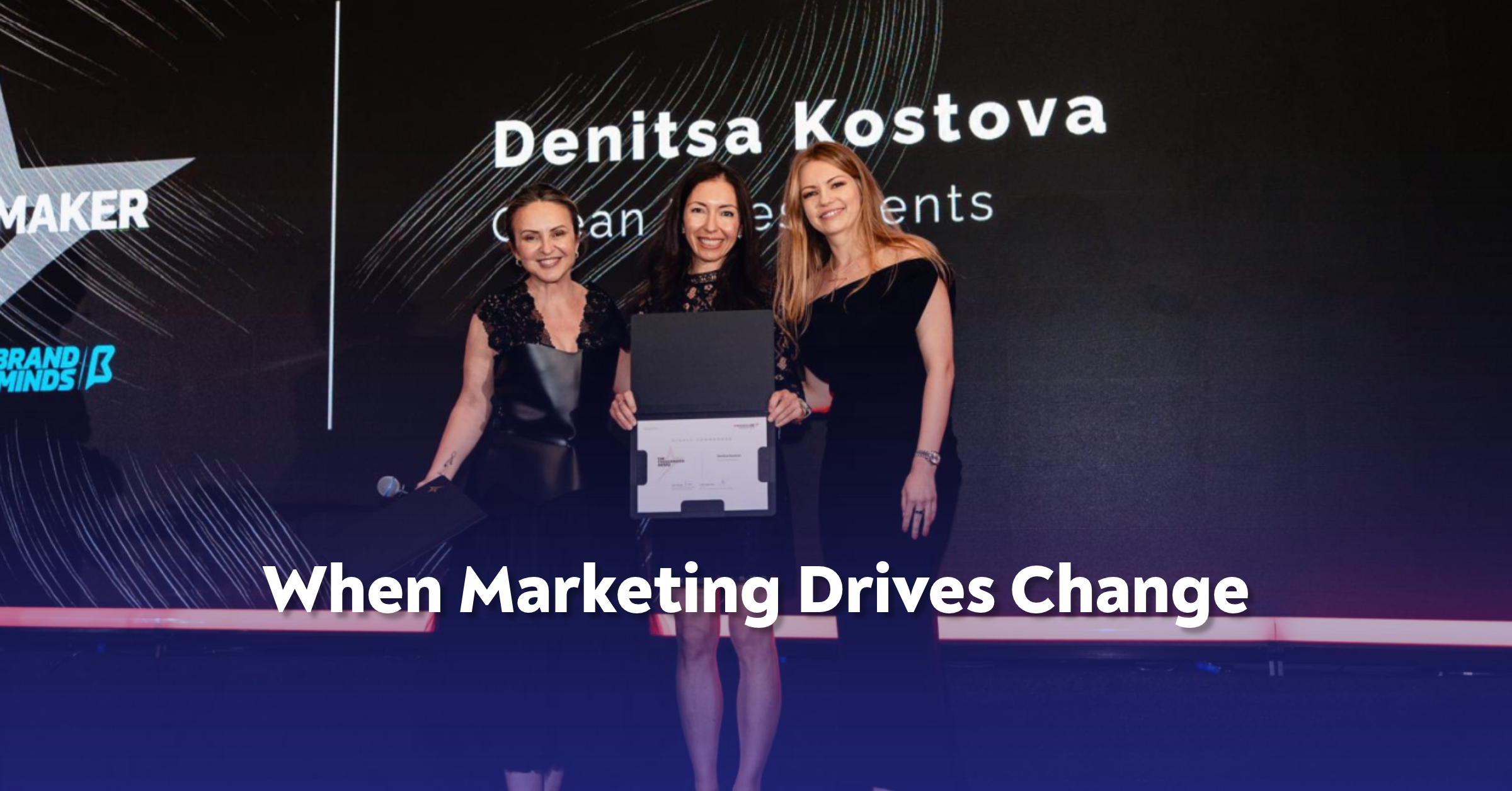
Denitsa Kostova receives a Highly Commended distinction at the Women in Marketing CEE Awards, bringing another perspective to Ocean Evolution and the changes taking shape across our ecosystem.
Apparently, organizational transformation can get you a marketing award, too.
At least, that’s one way of looking at what happened at Ocean Investments over the past few weeks.
In September, Ocean received the 2026 Transformational ZeroDX Award in Qingdao, China, recognizing its progress toward a decentralized, entrepreneurial operating model.
Just over a week later, on October 1, Ocean’s CMO, Denitsa Kostova, received a Highly Commended distinction in the Changemaker category at the inaugural Women in Marketing CEE Awards in Bucharest, Romania.

Two different awards. Two different fields. And two very different kinds of achievement.
Yet, both have something in common: Ocean Evolution.
Denitsa’s recognition is a personal achievement, reflecting her work challenging the traditional boundaries of marketing, experimenting with AI, and bringing customer-centric thinking into the organizational transformation happening at Ocean.
She has already told that story herself in A Changemaker, officially, and it’s well worth reading.
But there’s another side to it that deserves some attention.
What happens when an organizational transformation starts changing how people think about their own professions?
When transformation escapes the meeting room
Most organizations are quite good at announcing change.
New strategies get presented. Ambitious goals appear on slides. Someone introduces a new framework, preferably with an acronym everyone will spend the next few months trying to remember.
Then comes the difficult part.
The people who listened to those presentations have to return to their actual jobs and figure out what any of it means on a Tuesday morning.
For an engineer, it might mean getting involved in conversations about customers and business models. For someone in operations, taking ownership of a problem they previously would have escalated. For a manager, learning to step away from decisions they have spent years making.
And for a marketer?
Perhaps realizing that their contribution to a business can extend far beyond the boundaries of marketing itself.
This is one of the interesting challenges behind Ocean Evolution.
The transformation aims to move decision-making closer to customers, give teams greater autonomy, and create more room for entrepreneurial initiative across Ocean’s 2,500-person ecosystem.
But changing structures is only part of the equation.
The harder questions concern the people working within them. What happens to existing roles when teams become responsible for their own business outcomes? How do people develop capabilities that were never part of their original job descriptions? And how do different functions learn to work together when the traditional boundaries between them begin to shift?
These questions don’t have particularly convenient answers.
Which is why it’s interesting when they start appearing in places you wouldn’t necessarily expect.
Like a marketing awards ceremony.

What does marketing have to do with decentralization?
Quite a lot, as it turns out.
One of the central ideas behind Ocean Evolution is reducing the distance between the people making decisions and the customers affected by them.
That sounds straightforward until you consider how many decisions inside a large organization are made by people who rarely speak to those customers directly.
Marketing has traditionally been one of the functions closest to understanding markets, audiences, and customer behavior. But that knowledge doesn’t always travel far enough through the business.
And there’s a bigger opportunity here.
What if customer understanding became a capability shared by engineers, security specialists, operations professionals, and everyone else developing products and services?
What if marketing helped make that happen?
This is where Denitsa’s work connects directly with Ocean Evolution.
Through accelerator programs running in successive waves, teams across Ocean are learning to identify customer problems, validate demand, develop business models, and pitch opportunities they could eventually take ownership of.
Denitsa’s contribution has been to bring a marketer’s understanding of customers into that process, helping people from different professional backgrounds approach their ideas from the perspective of the people they hope to serve.
It’s an interesting shift in itself.
A skill developed through years of marketing practice becomes useful far beyond the marketing department.
And a profession often associated with communicating business value becomes involved much earlier, when that value is still being discovered.
Of course, there’s a difference between making customer-centricity part of a presentation and making it part of everyday decision-making. Ocean is still working through that challenge.
But these experiments offer a glimpse of what can happen when people begin contributing outside their familiar professional boundaries.
The ripple effects of a changing organization
There’s a temptation to measure organizational transformation by the things that are easiest to see.
New structures. New processes. New teams. New responsibilities.
Those things are important, and Ocean Evolution has made tangible progress on several of them.
The first wave of its accelerator brought together 16 teams, with 13 completing the initial program and presenting their business opportunities at Pitch Day in April 2026. Further waves have followed, each creating opportunities to test how greater autonomy and entrepreneurial ownership work in practice.
But some changes are harder to capture in a progress report.
A person starts asking questions that used to belong to another department. Someone experiments with a tool that solves a problem beyond their immediate responsibilities. A team discovers that its original idea doesn’t match what customers actually need and decides to change direction.
These moments may seem small compared to a redesigned operating model.
Yet they’re precisely the kinds of changes that determine whether a transformation eventually becomes part of how an organization works.
And they raise an interesting possibility: when people have more room to explore, the organization may discover capabilities it didn’t know it had.
Denitsa’s recognition offers one example of that possibility.
Her work with AI, innovation, and customer understanding has taken her into areas that don’t fit neatly within a conventional marketing role. At the same time, Ocean Evolution has created a broader context in which challenging those professional boundaries becomes increasingly relevant.
That doesn’t mean the transformation is complete, or that everyone across the ecosystem is suddenly working without silos.
Far from it.
But it does suggest that some of the most meaningful changes may come from how people begin to see their own contribution to the business.

Two recognitions, and plenty of work ahead
And so, it’s interesting to see the same transformation recognized in two such different contexts.
The ZeroDX Award acknowledged the organizational changes Ocean has been putting into practice.
The Women in Marketing CEE distinction recognized an individual whose work is helping expand the contribution marketing can make within that changing environment.
It’s worth celebrating both, while remembering that awards capture moments in journeys that continue long after the ceremonies end.
There are still questions about how autonomy should work, how teams can collaborate without recreating unnecessary hierarchy, and how customer understanding can become an everyday practice rather than a principle everyone agrees with in theory.
There are also questions about the future of professional roles as AI and new ways of working change what individuals and teams are capable of doing.
Denitsa is exploring some of those questions through marketing. Others across Ocean are approaching them from entirely different disciplines.
And that’s perhaps the most interesting part of seeing Ocean Evolution recognized from more than one direction.
A transformation that begins with rethinking how a company operates can eventually lead people to rethink what they do within it.
You can change an organizational chart without changing how anyone thinks.
The reverse is considerably more interesting.